The fast ferry to Korea
is gone. This one isn’t.
Every page promising a three-hour-forty hydrofoil to Busan is out of date: JR Kyushu sold the Queen Beetle and left the route. One operator survives, it takes six hours, and it is a two-night add-on rather than a day trip.
Camellia Line's New Camellia is now the sole Hakata–Busan sea link. Daytime sailings leave Hakata around 12:30 and arrive about 18:30 — roughly six hours — with an overnight pattern departing about 20:00 and arriving 07:30, around 11.5 hours. Fares start at ¥12,000 (~$80) one way in the cheapest class, plus ¥500 (~$3.35) Hakata port tax and a ¥1,200 (~$8) fuel surcharge, so a return starts near ¥24,000 (~$160) before charges. Sailings run roughly three times a week each way from Hakata Port International Terminal, about 15 minutes by bus from Hakata Station. Most Western passports need no K-ETA through 31 December 2026 — but the digital e-Arrival Card has been mandatory since 1 January 2026.
The Queen Beetle is not coming back
The correctionIf you've read that you can hop a hydrofoil to Korea in under four hours, that information is dead.
JR Kyushu ran a high-speed craft on the Hakata–Busan route for more than three decades. It was pulled from service after the hull cracked and took on water on separate occasions and the incidents were concealed for months; reinforcing the vessel for Korea Strait conditions was judged impractical. JR Kyushu sold the ship to the Korean operator PanStar and exited the Japan–Korea route entirely. There is no replacement hydrofoil, and the Korean-side high-speed service has not resumed on this run either. Every English page still describing a 3h40 crossing is describing a service that no longer exists.
What survives is the conventional ferry. Camellia Line's New Camellia is a proper ship rather than a jetfoil: it carries cars, it has cabins, tatami rooms and a bath, and it takes six hours in daylight or sits on the strait overnight. That is a different product with a different reason to buy it. You are not saving time; you are buying a crossing, a luggage allowance that laughs at LCC baggage rules, and — on the overnight sailing — a bed that doubles as your hotel.
Being right about this is the whole value of this page. The same freshness problem runs through a lot of English-language Fukuoka coverage, which is why we date everything: this page was checked in early August 2026, and the fare floor is ¥12,000 (~$80) one way, not the ¥7,200 that circulates in older guides and aggregator listings.
The practical bit
The crossingThe comparison nobody wants to publish
Ferry or flightBusan is 55 minutes away by air, and budget fares are frequently at or below the ferry price. Here's the honest side-by-side.
| Camellia Line ferry | Budget flight | Verdict | |
|---|---|---|---|
| Time, terminal to terminal | ~6 h day · 11.5 h overnight | ~55 min | SKIP |
| Door to door | About 8 hours with transfers | 3–4 hours | SKIP |
| Price | From ¥12,000 (~$80) one way plus charges | Often at or below that on LCCs | DEPENDS |
| Luggage | Generous — this is a ship, not a cabin bin | Paid, weighed, argued about | WORTH IT |
| Saves a hotel night | Yes, on the overnight sailing | No | WORTH IT |
| The experience itself | Crossing the Korea Strait on deck at dusk | A 55-minute queue with wings | WORTH IT |
Read that honestly: the ferry loses on speed and usually ties on price. It wins on luggage, on the overnight cabin-instead-of-hotel trick, and on being a thing you did rather than a thing you endured. Buy it for those reasons or fly — but don't buy it believing it's faster or cheaper.
K-ETA, the e-Arrival Card, and the trap in between
The paperworkTwo separate systems, and travellers keep conflating them. K-ETA — Korea's electronic travel authorisation — is waived for 22 visa-waiver jurisdictions through 31 December 2026, a list that includes the US, UK, Canada, Australia, France, Germany, Italy, Spain, Singapore and Japan. So most Western passport holders on a short visit need no K-ETA at all in 2026.
The e-Arrival Card is the one that catches people. Since 1 January 2026 it has been mandatory, filed free online at the Korean government's e-arrival portal within three days before you arrive. Holders of a K-ETA and registered residents are exempt — everyone else, including visa-exempt travellers, must file it. Which means the K-ETA waiver that saves you one step obliges you to do the other. Children under 14 are filed by a guardian. Do it from your hotel in Fukuoka the day before you sail; it takes minutes and there is no fee.
Beyond that: carry your passport (this is an international border crossing, with immigration at both ends), keep some cash for the Korean-side port charges, and remember that Japanese tax-free purchases interact with departures — from 1 November 2026 Japan switches to refund-at-departure, which the money page covers. Allow a full hour at Hakata Port before the daytime sailing.
Frame it as two nights, not a day out
How to actually use itA same-day return is physically impossible: the daytime sailing arrives in Busan at 18:30 and the only way back is a later crossing on a later day. The shape that works is sail out on the 12:30, one or two nights in Busan, then a daytime or overnight return — a two-night add-on bolted to the end of a Fukuoka stay. That's a genuinely appealing trip, and it is the correct way to think about the ¥24,000 (~$160) return fare: it's the price of a leg of your itinerary, not the price of an excursion.
The variant worth knowing: the Busan–Shimonoseki ferry lands you in Yamaguchi instead, from which you work back through Kokura — which pairs neatly with the Mojiko and Kokura day and gets you a different stretch of coast on the return. And the context that makes all of this feel less exotic than it sounds: over half of Fukuoka's foreign visitors are Korean weekenders. This is a well-worn commuter route between two cities that consider each other close.
Fukuoka's crowds don't follow Japan's national pattern: over half its foreign visitors are Korean weekenders, with Taiwan next — this is Asia's short-break city, not a Western tour-bus stop. Practical consequence: weekends and Korean holidays are the crush; Western-peak months matter less than you'd think.
Tickets, flights and a Korean data plan
What we can and can't bookWe have no affiliate arrangement with Camellia Line — book the sailing directly on the operator's own site, linked in the facts above. What follows is the honest adjacent set: the flight comparison and the data plan you'll want the moment you land.
Fukuoka to Busan, answered
FAQPage schema pairedCan you still take a fast ferry from Fukuoka to Korea?
No. JR Kyushu sold the Queen Beetle to PanStar and exited the Japan–Korea route after more than 30 years, following concealed hull flooding, and no replacement hydrofoil runs. The only surviving sea link is Camellia Line's conventional ferry: about six hours in daylight or 11.5 hours overnight.
How much is the ferry from Fukuoka to Busan?
From ¥12,000 (~$80) one way in the cheapest tatami or dormitory class, plus a ¥500 (~$3.35) Hakata port tax and a fuel surcharge of about ¥1,200 (~$8). Korean-side port and fuel charges are collected in cash in won. A return therefore starts near ¥24,000 (~$160) before charges — not the ¥7,200 older guides still print.
Can I do Busan as a day trip from Fukuoka?
No, categorically. The daytime sailing leaves Hakata around 12:30 and arrives in Busan around 18:30, and there is no same-day return. Treat it as a two-night add-on: sail out, one or two nights in Busan, sail back. As that, it's a good idea; as a day trip it doesn't exist.
Do I need a K-ETA to enter Korea?
Most Western tourists don't in 2026 — the K-ETA requirement is waived for 22 visa-waiver jurisdictions, including the US, UK, Canada, Australia, France, Germany, Italy, Spain, Singapore and Japan, through 31 December 2026. Check your own nationality against the current list; the waiver has an expiry date attached to it.
What is the e-Arrival Card and do I need it?
A free digital arrival declaration, mandatory since 1 January 2026 and filed online within three days before you arrive. K-ETA holders and registered residents are exempt — everyone else, including visa-exempt travellers, must file. So the K-ETA waiver does not get you out of this one. Under-14s are filed by a guardian.
Is the overnight sailing worth it over the daytime one?
If you're travelling light on budget, yes — the cabin replaces a hotel night, so the effective cost drops sharply, and you wake up in Busan at 07:30 with a full day ahead. If you want the crossing itself, take the daytime sailing: six hours of the Korea Strait in daylight is the actual experience you're paying for.
How do I get to Hakata Port?
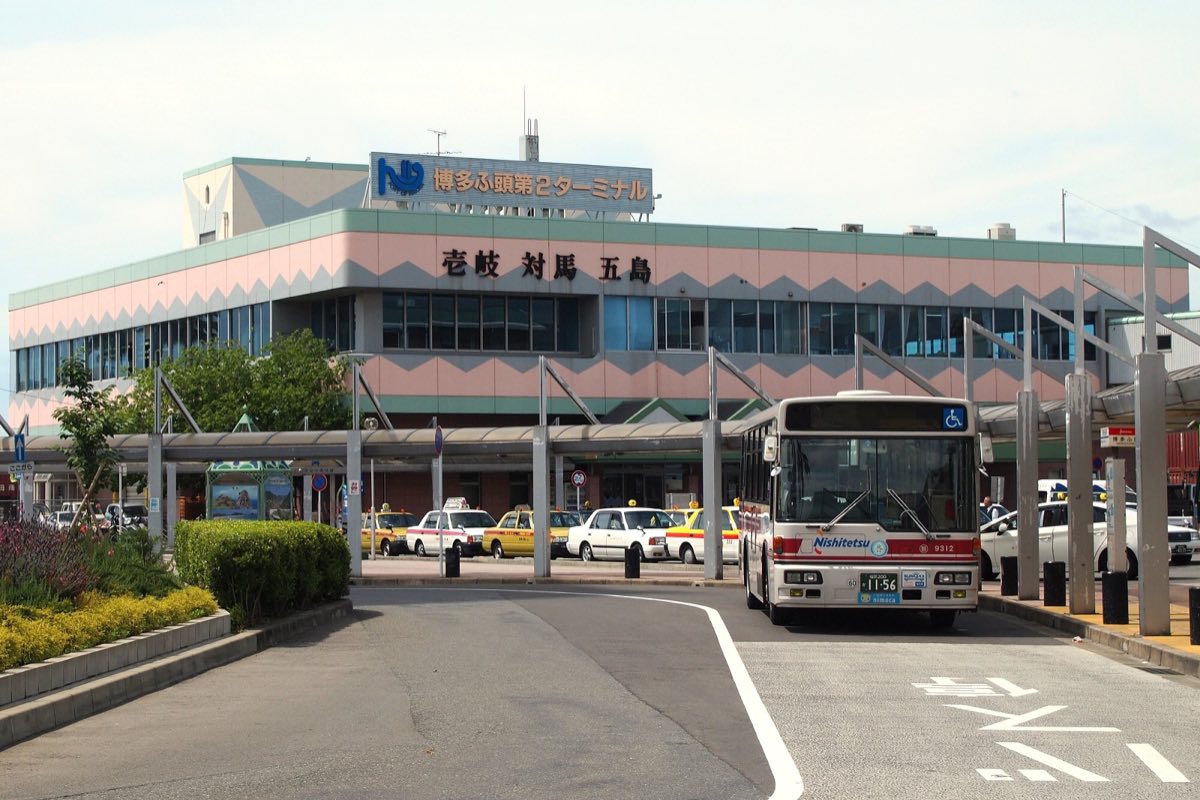
About 15 minutes by bus from Hakata Station or Tenjin to the Hakata Port International Terminal — this is the international terminal, not the domestic ferry pier for the islands. Allow a full hour before a daytime sailing for check-in and immigration. Getting around the city: the transport page.
Should I just fly instead?
Often, yes — Busan is 55 minutes by air and budget fares regularly match or beat the ferry. Take the ferry if you're carrying luggage that airlines would punish, if the overnight cabin saves you a hotel night, or if crossing the strait by sea is the point. Don't take it expecting to save time or money.