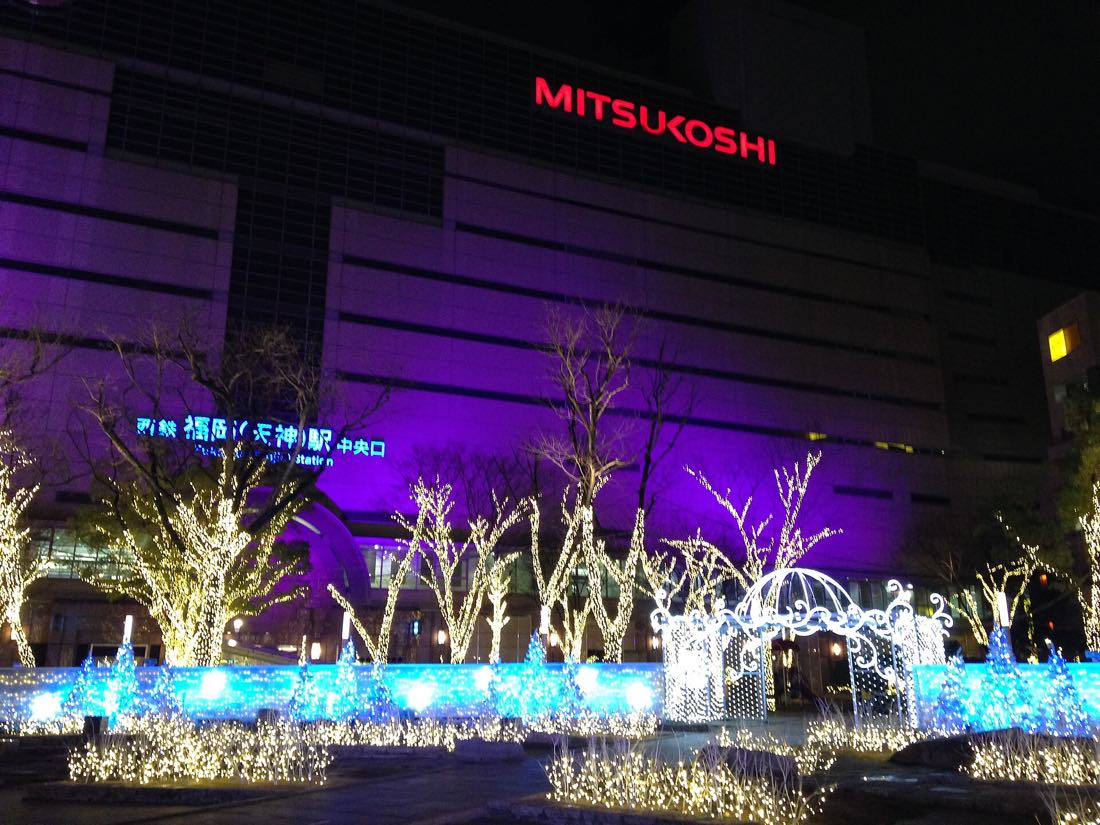
Tenjin & Daimyo:
sleep where the night ends.
Kyushu's retail heart, its bar district, and — since 2025 — a finished skyline. The premium over Hakata is ¥2,000–5,000 a night; whether it's worth paying depends entirely on what time your evenings end.
Tenjin is Fukuoka's lifestyle centre — department stores, the 590 m Tenjin Chikagai underground arcade, the prefecture's bus hub, and bars that pour until 2–3am. Rooms run ¥10,000–18,000 ($67–120), roughly 15–20% above comparable Hakata beds, and the premium buys exactly one thing that matters: you can walk home after the subway stops around midnight. Daimyo, five minutes west, adds vintage shops, tiny 8-seat bars and the Ritz-Carlton at its edge. If your evenings end by 22:00, save the money and sleep in Hakata; if they don't, this is the only sensible answer. And book Tenjin during Yamakasa week — Hakata-side rates double, this side doesn't.
The last-train gap is the whole argument
The real reasonStrip away the shopping and the argument for paying Tenjin prices reduces to a timetable.
The subway stops around midnight; Fukuoka's bars and yatai run to 2–3am. That gap is the single best reason to sleep in Tenjin or Daimyo if you're here for the nightlife — or to budget for the taxi and stay in Hakata anyway, where everything else is easier.
Here's the arithmetic behind it. Fukuoka's subway runs roughly 05:30 to around midnight — earlier than Tokyo's — while the bars close at 2–3am and the clubs at 5. That leaves a two-to-five-hour hole with no trains. A taxi bridges it for ¥1,000–1,500 ($7–10) from Nakasu to Hakata Station (base fare ~¥590, plus a 20% surcharge 22:00–05:00), which is cheap once and corrosive nightly. Sleep in Tenjin or Daimyo and the gap simply never applies: Oyafuko-dori, the Daimyo bars and the Tenjin yatai rows are all a stroll from bed. That's the trade — pay ¥2,000–5,000 more per night, delete every closing-time calculation from your trip.
Tenjin Big Bang: the cranes won — and left
The 2026 storyIf you last read about Tenjin being 'one big construction site', your information has expired.
Tenjin Big Bang is the city's decade-long deregulation scheme to rebuild its centre — around 120 buildings, with 74 already done by March 2025. The marquee openings have landed: ONE FUKUOKA BLDG opened at the Tenjin crossing on 24 April 2025 with 126 shops and 60 brands new to Kyushu, the 113 m Sumitomo Life FJ tower followed that September, and Daimyo Garden City — the mixed-use block carrying the Ritz-Carlton — is complete. The story for 2026 is completion, not construction: planners themselves call this the year the 'construction era' ends and the 'operation era' begins.
What that means at street level: the new Tenjin is open and worth your evening, with scattered mid-block rebuilds still running — background city noise, not a ruined stay. If you're a light sleeper, scan a hotel's recent reviews for construction mentions before booking a low floor. Between errands, don't miss the one Tenjin building that predates the boom and beats it: ACROS Fukuoka, the office block wearing a terraced forest.
Daimyo: the quarter that stays up with you
The back streetsFive minutes' walk west of the Tenjin crossing, the street grid shrinks to samurai-era widths and the businesses shrink to match: vintage clothing, independent roasters, craft-beer taps, galleries, and bars seating eight. This is Daimyo — routinely called Fukuoka's Shimokitazawa, and the best-balanced atmosphere-plus-centrality pick in the city for anyone whose evenings involve more than one venue. The coffee scene clusters here and in Imaizumi just south.
Two practical warnings. The pavements are extremely narrow — guides specifically flag that big suitcases are a genuine nuisance here, so pack accordingly or stay nearer the station grid. And the last block toward Oyafuko-dori carries weekend noise into the small hours; that street's name translates as 'disobedient children's street', and it earns it — book a couple of blocks away, not on it. Small-hotel rooms run ¥6,000–14,000 ($40–93); the Ritz-Carlton (2023, spa on floor 24) tops the quarter at ¥80,000+ (~$530+).
Is Tenjin your side of the river?
Who it suitsThe practical bit
Plan the stayStay search, aimed at Tenjin
Book itFilter by map pin: the Tenjin grid for convenience, the Daimyo blocks for character — and skip anything fronting Oyafuko-dori if you sleep lightly.
Tenjin & Daimyo, answered
FAQPage schema pairedIs Tenjin still a construction site?
No — that reputation is out of date. The Tenjin Big Bang rebuild hit its landmark openings in 2025 (ONE FUKUOKA BLDG in April, the 113 m Sumitomo Life FJ tower in September, Daimyo Garden City complete), and 2026 is officially the operation era, not the construction era. Expect scattered mid-block hoardings at worst.
How much more does Tenjin cost than Hakata?
Guides put comparable rooms 15–20% higher — call it ¥2,000–5,000 a night on a midrange bed. The honest advice both ways: that gap shouldn't decide your booking; your trip pattern should. The full head-to-head is at Hakata or Tenjin?
What time does the subway really stop?
Services wind down around midnight — earlier than Tokyo — and restart about 05:30. Bars here run to 2–3am and weekend clubs to 5, so anyone out late either walks home or taxis (¥1,000–1,500/$7–10 for the Nakasu–Hakata kind of hop, with a 20% late-night meter surcharge). Staying in Tenjin is how you opt out of that decision.
Where are the yatai in Tenjin?
Along Watanabe-dori and the Shōwa-dori fringes, in rows locals rate above the Nakasu postcard strip — ask prices first, carry cash, expect a one-drink minimum. Stall-by-stall strategy, fair-bill numbers and the five rules: the yatai guide.
Is Daimyo a good place to actually sleep?
Yes for anyone travelling light who wants bars and cafés at walking distance — it's the city's best atmosphere-plus-centrality balance. Two caveats: the narrow lanes make heavy luggage genuinely annoying, and rooms near Oyafuko-dori collect weekend noise. Small hotels run ¥6,000–14,000 ($40–93).
Should I stay in Tenjin during Yamakasa?
It's the recognised workaround: the festival's 1–15 July surge hits Hakata-side hotels hardest — rates there are reported to double — while Tenjin, across the river, stays saner. You're still one ¥210 subway hop from the 4:59am start line at Kushida Shrine. Dates and strategy: Fukuoka events.
Is Tenjin better than Hakata for day trips?
For Dazaifu and Yanagawa, yes — both leave from the Nishitetsu terminus inside Tenjin. For shinkansen trips (Kumamoto, Hiroshima) and the wider ranked list, Hakata wins. Match your base to your itinerary's railway, not the other way round.
Related tickets, tours and stays
More ways to bookDeep links to specific products for the places on this page. Prices and availability are shown by each provider.