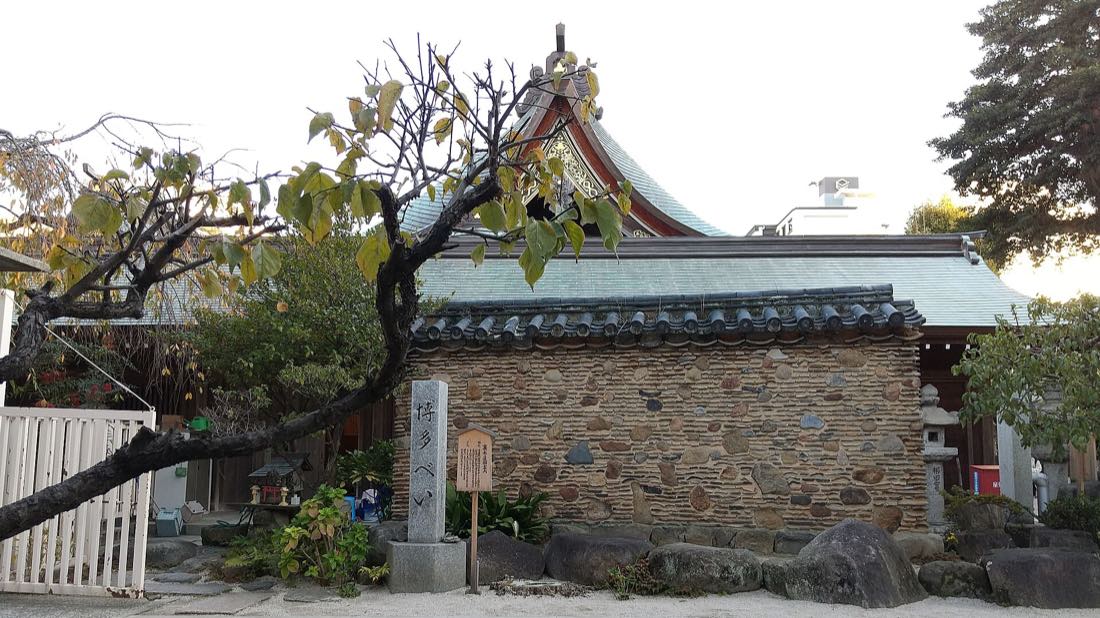
Kushida keeps the festival
on display all year.
Kushida Shrine is Hakata's guardian shrine and the spiritual home of the Yamakasa festival — and it keeps a 10-metre-plus kazariyama festival float on display in the grounds year-round, with one exception: June, when the new floats are built for their 1 July unveiling. Grounds are free and open 4:00–22:00; the small museum is ¥300 (~$2), 10:00–17:00, closed Mondays. Two minutes from Kushida Jinja-mae Station, 30 minutes well spent, best paired with the temple circuit next door.
The shrine that runs Hakata's calendar
What it isFounded by legend in 757, rebuilt in 1587 on Toyotomi Hideyoshi's instruction — and still the start line of Japan's most violent race.
Kushida is where Hakata Gion Yamakasa climaxes: at 4:59 on the morning of 15 July, seven one-tonne floats are raced out of these grounds by teams of men who have spent a fortnight abstaining from cucumber — a taboo the official festival guide is entirely serious about. The festival is UNESCO Intangible Cultural Heritage; the other 50 weeks of the year, you get its best artefact without the 3am alarm, because a full decorative kazariyama float stands in the grounds on permanent display.
The one scheduling trap: the float is absent in June, when the new year's floats are constructed for unveiling on 1 July. Go any other month and it's there, ten metres of gods and warriors in silk and gold. If you miss it, a second permanent float stands in Kawabata Zenzai Hiroba, three minutes away in the shopping arcade.
Also in the grounds: the 'Kushida no Ginan' ginkgo, said to be over a thousand years old, which turns the courtyard gold in late November; the giant otafuku face gates at Setsubun in February; and the anvil-flat stone the sumo association donates lifting stones beside. TripAdvisor has it at 4.1 from 1,668 reviews — the highest-rated thing in Fukuoka that isn't a park or a train station, which in this city is the crown.
Is Kushida for you?
Who it suitsThe practical bit
Plan your visitSee it with the festival politics explained
Go deeperKushida needs no ticket and no tour. Book a guide if you want the Yamakasa story — why the floats race, what the merchant guilds still fight about — told while you stand where it happens.
Kushida Shrine, answered
FAQPage schema pairedIs the Yamakasa float really on display all year?
Eleven months of it. The kazariyama stands in the grounds year-round except June, when the new floats are built for their 1 July unveiling. If you're here in June, the permanent float at Kawabata Zenzai Hiroba — three minutes away in the arcade — covers you.
How much does Kushida Shrine cost?
The grounds are free, open 4:00 to 22:00 — yes, four in the morning; Yamakasa men train early. The small museum of festival artefacts is ¥300 (~$2), open 10:00–17:00 and closed Mondays. Goshuin stamps are written 9:00–17:00.
How do I get there?
Kushida Jinja-mae Station on the Nanakuma line puts you two minutes from the gate — one stop, ¥210 from Hakata. Or walk: 15–20 minutes from Hakata Station, 5 from Gion Station, which lets you take the whole temple circuit in on the way.
When is the best time to visit?
Late November, when the thousand-year ginkgo turns and the Old Town light-up walk illuminates the district. For the festival itself, 1–15 July — but hotels sell out, and the oiyama race means being at the barriers before 4:59am on the 15th. Ordinary weekday mornings are near-empty.
Is it worth it during Yamakasa if I can't do the 4:59am race?
Yes — from 1 July the freshly built kazariyama floats are displayed at points across Hakata and Tenjin, and the shrine hums for the whole fortnight. Book beds early: dates and sellout detail at Fukuoka events.
Kushida or Tochoji if I only have time for one?
Tochoji for an interior — the giant Buddha and the hell walk work in any weather for ¥50. Kushida for atmosphere and the float. They're eight minutes apart, so the honest answer is both: it's the spine of the temple walk.
Related tickets, tours and stays
More ways to bookDeep links to specific products for the places on this page. Prices and availability are shown by each provider.