The best 26 minutes
you can spend from Hakata.
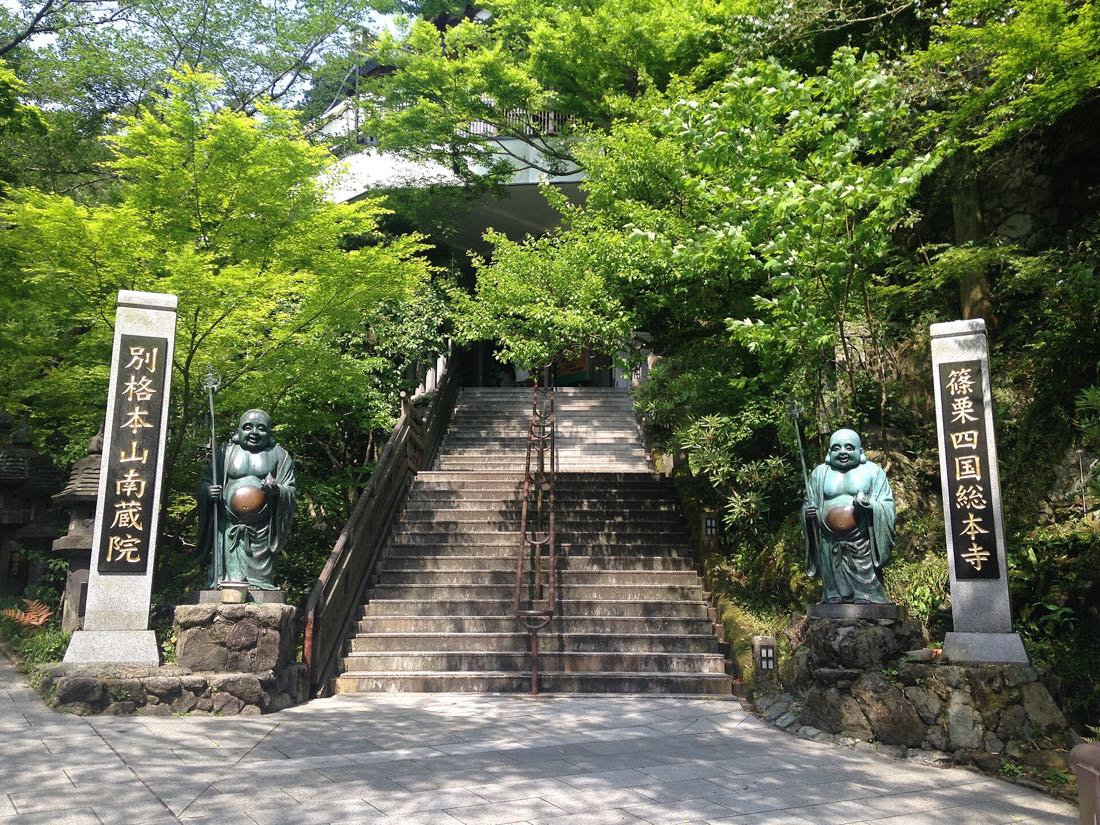
A 41-metre bronze reclining Buddha, roughly the length of the Statue of Liberty, one local train from Hakata Station. It is also a working temple that has had a difficult few years with visitors — both halves of that matter.
Take the JR Sasaguri line (Fukuhoku Yutaka line) from Hakata to Kido-Nanzoin-mae: 26 minutes, ¥380 (~$2.55), then five minutes on foot. The reclining Buddha is 41 metres long, 11 metres tall and around 300 tonnes of bronze — billed as the largest bronze reclining Buddha in the world. Since May 2025 the temple charges foreign visitors ¥300 (~$2); residents of Japan are exempt with proof, and Japanese nationals aren't charged. The Buddha area is open 09:00–17:00 with last entry 16:30. Allow three hours door to door, dress modestly, cover tattoos, and keep your voice down — this is a functioning temple, not a photo stop.
Why foreign visitors pay ¥300 — and why we're telling you
The fee, straightThis is the part other guides either omit or get indignant about. It deserves neither.
Since May 2025, Nanzoin has charged foreign visitors an entrance fee of ¥300 (~$2) to the reclining Buddha area. Japanese nationals are not charged. Foreign residents of Japan are exempt on production of proof of a long-term work or study stay, and there are reported reductions for under-18s and for registered tour groups. The temple's stated reason is nuisance behaviour and the cleaning and security costs that followed a sharp rise in visitors — the change was covered widely in Japanese and international press in mid-2025, and it drew real criticism as a foreigner-only charge.
Our position is simple and we'd rather state it than dodge it. A two-tier fee based on nationality is unusual in Japan and genuinely uncomfortable to write about. It is also ¥300 — about the price of a canned coffee — levied by a small mountain temple that never asked to become a bus-tour stop and now spends money on cleaning and stewarding it didn't spend a decade ago. You can think the mechanism is the wrong one and still pay it without complaint. What you shouldn't do is turn up unaware, because the surprise is what turns a ¥300 coin into an argument at a temple gate.
The behavioural background is worth understanding rather than sneering at: this is an active place of worship on the Sasaguri pilgrimage circuit, with monks, services and parishioners, that acquired an enormous photogenic object and then acquired crowds who treated the grounds as a set. The conduct rules below are the temple's answer. Follow them and you will be entirely welcome.
The conduct rules, and they're enforced
Before you goNone of these are onerous. All of them are the difference between a visitor and a problem.
Shoulders, midriff and knees covered. This is stated policy, not etiquette advice — vest tops and short shorts are the specific issue.
A light long-sleeve layer in your bag solves it in summer heat.The temple asks for tattoos to be covered. Long sleeves, a rash guard or tape; the same convention you'd meet at an onsen.
Services run during opening hours and parishioners are praying a few metres from where you're standing. Group chatter carries a long way up a hillside.
There is no blanket photography ban that we could verify, but the temple asks for restraint and posts signage by zone. Read the signs where you're standing, and don't stage anything.
The grounds climb, the paths are uneven and parts are gravel. Comfortable closed shoes; this is a hillside temple complex, not a plaza.
The practical bit
Plan the trip300 tonnes of bronze on a Kyushu hillside
What you're looking atScale is the whole experience. At 41 metres the Buddha is roughly as long as the Statue of Liberty is tall, and because it lies down on a hillside rather than standing on a plinth, you approach along its length and the size arrives gradually rather than all at once. Coloured cords are tied to the statue's hand and run down to where visitors stand; holding one is the local devotional gesture, and it is the moment most people remember rather than the photograph.
The temple is also site No. 1 of the Sasaguri Hachijuhakkasho, an approximately 180-year-old pilgrimage circuit of 88 sites modelled on Shikoku's. Walking the full loop is about 50 kilometres and a multi-day proposition; a realistic version is a half-day sampler of five to eight nearby temples on foot from the station, which almost nobody does in English and which turns a two-hour trip into a genuinely different day. The main hall and the No. 45 temple stay accessible outside the Buddha area's hours.
Where it sits among the day trips: this is the cheapest and fastest large payoff from Hakata Station, which makes it the right answer for a half-day, a repeat visit, or the morning of a departure day. It is not a substitute for Dazaifu on a first trip — Dazaifu has a town, a museum and a food street around it, where Nanzoin is one enormous object and a hillside. Both are on the ranked list.
Booking, honestly
Guided, if you want the pilgrimage layerA ¥380 train ticket and a ¥300 entry are not a booking problem. A guide is worth it if you want the Shingon context, the pilgrimage circuit explained, or the conduct handled for you in a group.
Nanzoin, answered
FAQPage schema pairedHow do I get to Nanzoin from Hakata?
One local train: the JR Sasaguri line (signed as the Fukuhoku Yutaka line) from Hakata Station to Kido-Nanzoin-mae, 26 minutes and ¥380 (~$2.55), then about five minutes on foot. No transfers, no bus, no car. It is the simplest day trip in this entire set.
Is there really a foreigner-only entrance fee?
Yes. Since May 2025 foreign visitors pay ¥300 (~$2) to enter the reclining Buddha area; Japanese nationals are not charged, and foreign residents of Japan are exempt with proof of a long-term work or study stay. Reported reductions apply for under-18s and registered tour groups. Bring a ¥100 or ¥500 coin and treat it as part of the fare.
Why does the temple charge it?
The temple cites nuisance behaviour and the resulting cleaning and security costs after visitor numbers climbed sharply. It's a working temple with services running while visitors walk the grounds. You can disagree with a nationality-based mechanism — plenty of commentators did in 2025 — and still recognise a small temple trying to pay for stewardship it didn't previously need.
What are the dress and behaviour rules?
Shoulders, midriff and knees covered; tattoos covered; quiet voices; closed comfortable shoes for uneven, climbing paths. These are the temple's own requirements rather than general advice, and they're the reason some visitors report friction — nearly all of it avoidable by packing a light long-sleeve layer.
Can I take photos of the reclining Buddha?
Broadly yes, with restraint, and read the signage where you stand — the temple posts restrictions by zone and asks visitors not to treat the grounds as a set. We could not verify any blanket ban, so we're not printing one. What is clear: no night access to the Buddha, and no staged shoots.
How long does Nanzoin take?
Two to three hours door to door from Hakata Station, including the train both ways. Add a half day if you want to walk a stretch of the 88-temple Sasaguri circuit that Nanzoin anchors — five to eight nearby temples on foot is the realistic version of a route that runs about 50 km in full.
Is it worth it with children?
Yes — a 41-metre bronze figure lying on a hillside is the kind of scale children actually react to, the walk in is short, and the coloured cords give them something to do. The constraints are the quiet-voices rule and uneven ground, so it suits school-age kids better than toddlers. More: Fukuoka with kids.
Nanzoin or Tochoji for a giant Buddha?
Do both — they're different animals. Tochoji is a 10.8 m seated wooden Buddha eight minutes' walk from Hakata Station with a pitch-black hell walk underneath, for ¥50. Nanzoin is 41 m of bronze in the hills, 26 minutes out, for ¥380 plus ¥300. Tochoji is the better hour; Nanzoin is the better photograph.