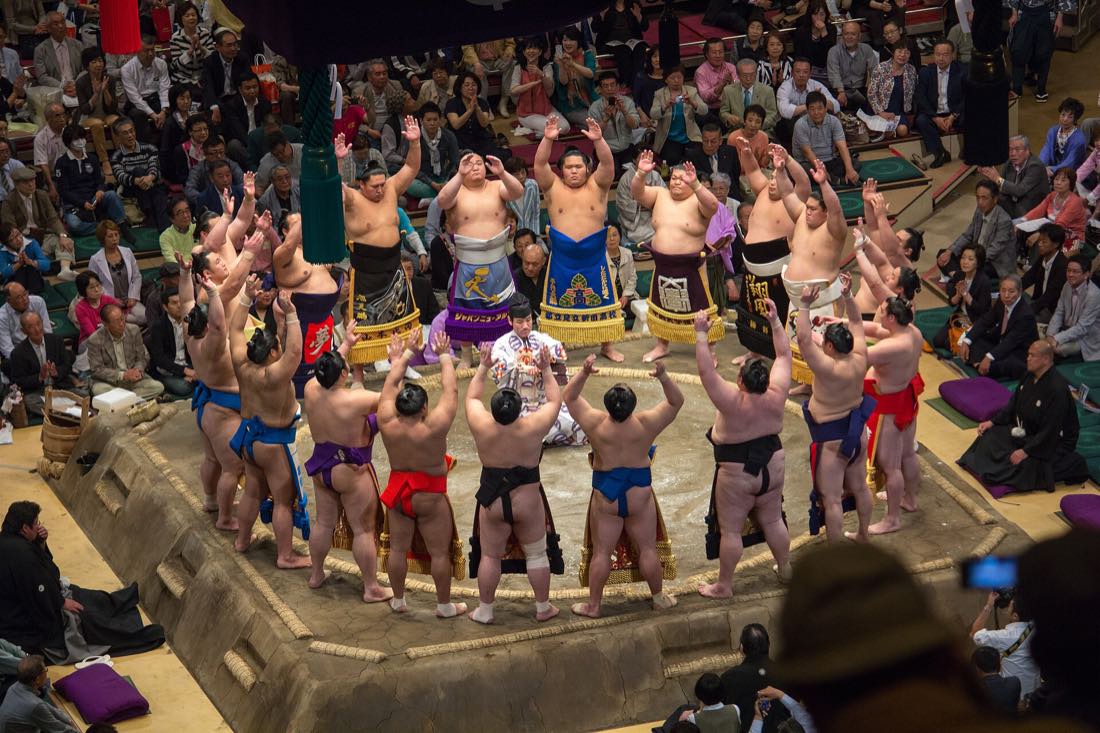
For fifteen days in November,
Fukuoka is unarguable.
The Kyushu Basho is one of Japan's six grand sumo tournaments and it runs 15 days every November at Fukuoka Kokusai Center — 8 to 22 November in 2026. Chair seats cost roughly ¥3,500–5,500 (~$23–37) a head, four-person boxes ¥34,000–60,000 (~$227–400), which is ¥8,500–15,000 (~$57–100) each. The hall seats about 7,500 on a single level, so even a cheap seat is close. Buy through Ticket Oosumo at sumo.pia.jp, which has English support; sales open around two months ahead. No online travel agent sells this — anyone claiming a 'bookable sumo package' is reselling.
The smallest big sumo venue in Japan
What it isRyogoku in Tokyo is tiered and cavernous. Fukuoka's hall is one level, about 7,500 seats, and the back row can still see faces.
Six grand tournaments run each year and Fukuoka gets the last one — the Kyushu Basho, fifteen straight days in November, in a conference hall by the port that spends the other eleven months hosting trade shows. That sounds like a downgrade and isn't: single-level seating means the cheap chairs sit closer to the clay than the good seats at Ryogoku, and the Kyushu basho has historically been the easiest of the six to get into. This is the one fortnight when the honest answer to 'does Fukuoka have a world-class sight?' is yes, with no framing required.
How a day works. Doors open early and the lower divisions start around 8:30 to a nearly empty hall — atmospheric, free of crowds, and mostly attended by people who know exactly what they're watching. The top-division makuuchi bouts run roughly 16:00 to 18:00, and that is when the hall fills, the ring-entering ceremonies happen and the noise arrives. The efficient play for a visitor: buy the cheapest chair seat, turn up at 15:00, and spend three hours on the good part.
Buying is the genuinely awkward bit, and it's why this page exists. There is no GetYourGuide or Klook product for basho tickets — the primary channel is Ticket Oosumo (sumo.pia.jp), which carries English support, alongside Ticket Pia and Japanese convenience-store terminals. English-language intermediaries including buysumotickets.com and fukuokasumo.tokyo will do it for you at a markup. Sales typically open about two months before the tournament, and weekends plus the final two days go first.
What a seat costs, and what you get
The pricesSources quote weekday and weekend prices separately; the ranges below cover both. Boxes are sold as a unit of four, cushions on the floor, shoes off.
| Seat | Price | Per person | Verdict |
|---|---|---|---|
| Chair Seat B — the visitor's choice | ¥3,500–4,000 (~$23–27) | ¥3,500–4,000 | WORTH IT |
| Chair Seat A | ¥5,000–5,500 (~$33–37) | ¥5,000–5,500 | WORTH IT |
| Masu-seki C box, seats 4 | ¥34,000–38,000 (~$227–253) | ¥8,500–9,500 (~$57–63) | DEPENDS |
| Masu-seki B box, seats 4 | ¥42,000–46,000 (~$280–307) | ¥10,500–11,500 (~$70–77) | DEPENDS |
| Masu-seki A box, seats 4 | ¥56,000–60,000 (~$373–400) | ¥14,000–15,000 (~$93–100) | DEPENDS |
Boxes are the traditional experience and a genuine test of your knees — four adults, cushions, ninety minutes before anyone can pretend it's comfortable. Two people rarely need to buy four seats: chair seats put you in the same hall for a tenth of the money. Ranges reconcile two published price lists; confirm the exact band on the ticket page before you pay. Every price on this page was checked in early August 2026 against official or primary sources. Japanese attraction prices move and English sources go stale fast; where we couldn't verify a number, we say so instead of guessing.
The sumo calendar, working backwards
Book byMorning practice, with a guide
The one bookable productNo online agent sells tournament tickets — that's Ticket Oosumo's job. What is bookable is the morning asageiko visit, the most reviewed in-city cultural product in Fukuoka, paired with a walk through the old town.
Is the Kyushu Basho for you?
Who it suitsThe practical bit
Plan the daySumo in Fukuoka, answered
FAQPage schema pairedWhen is the sumo tournament in Fukuoka?
Every November — the Kyushu Basho, the last of the six annual grand tournaments, running 15 consecutive days. In 2026 that's 8 to 22 November at Fukuoka Kokusai Center. There is no sumo here in any other month; the venue reverts to conferences.
How do I buy Kyushu Basho tickets?
Ticket Oosumo at sumo.pia.jp is the primary channel and has English support; Ticket Pia and Japanese convenience-store terminals sell the same inventory. Sales open roughly two months ahead. No OTA — Klook, GetYourGuide, none of them — sells basho tickets, whatever a listicle tells you.
How much are tickets?
Chair seats run about ¥3,500–5,500 (~$23–37) per person depending on grade and whether it's a weekend. Four-person masu-seki boxes run ¥34,000–60,000 (~$227–400), which works out at ¥8,500–15,000 (~$57–100) a head. Chair seats are the sane choice for two people.
What time should I arrive?
Fifteen hundred. The hall opens early and lower-division bouts start around 8:30 to almost nobody, which has its own charm, but the top-division makuuchi bouts run roughly 16:00–18:00 and that's the sumo you came for — ceremonies, salt, noise, and a hall that's suddenly full.
Can I see sumo practice instead?
Yes, morning asageiko visits are sold as guided tours from about $74 — the most-reviewed in-city cultural product in Fukuoka at 4.2 from 22 reviews. Listings run year-round, but the stables are only in Fukuoka around the November basho, so verify what your date actually includes before booking.
How do I get to Fukuoka Kokusai Center?
Gofukumachi Station on the Hakozaki line, then about 12 minutes on foot; Nakasu-Kawabata is 15 minutes away and lets you walk in through the old town. From Hakata Station a taxi or bus takes about 10 minutes. Fares: getting around Fukuoka.
Will I get a hotel during the basho?
Only if you book early. November sumo is one of the four dates that sell Fukuoka out, alongside Yamakasa in July, Dontaku in May and New Year. Dates and consequences: Fukuoka events; areas and prices: where to stay.
Is a November trip worth building around sumo?
It's the strongest reason to pick November over spring — sumo, autumn colour at Kushida's thousand-year ginkgo, and no baseball to compete with it. The trip-length argument: how many nights.